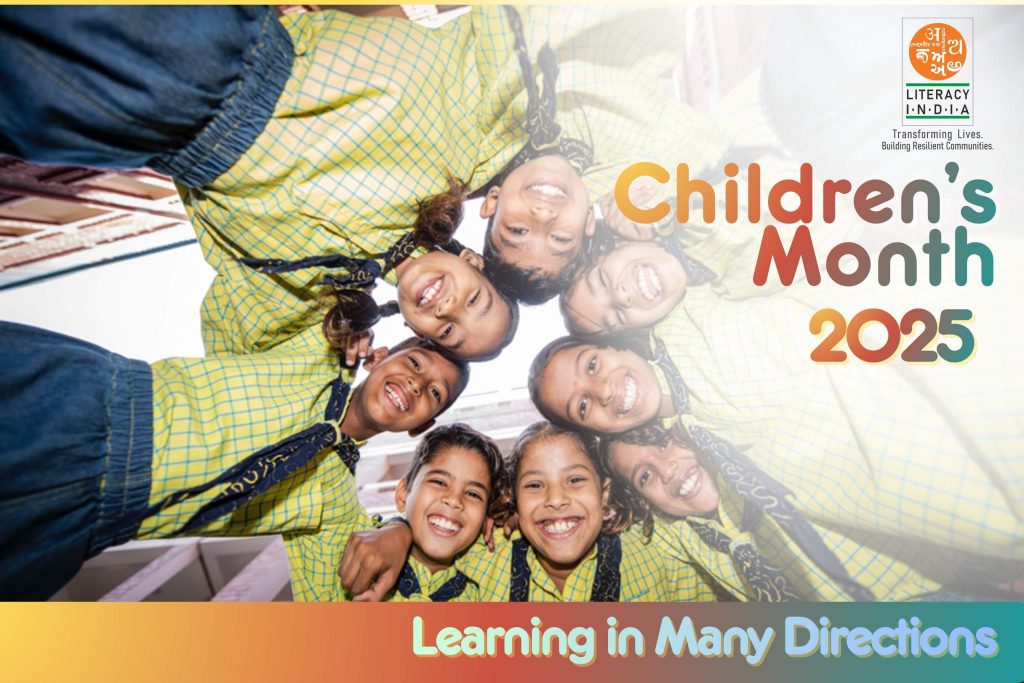
For nearly thirty years, November at Literacy India has belonged to children. This year again, our centres turned the month into a long, gentle festival of learning – not only through books and tests, but through streets, skies, screens, stage and science tables. From tiny hands holding crayons to teenagers debugging code, each age group met the world differently. What tied it all together was simple: joy, curiosity and the quiet message that you matter, your questions matter, your dreams matter.
Lowakui: A Day that Felt Like a Festival

At Lowakui Community Centre, Children’s Day on 14 November brought together around 150 children from Gyantantra and Remedial classes. The day opened with a talk on children’s rights, education and their role in nation-building, followed by songs, dances and a lively quiz on general knowledge, environment and healthy living.
The younger ones enjoyed the performances; the older ones loved the quiz and the chance to think aloud. The celebration ended with sweets for every child and a strong sense that this was their day.
Leh: Science, Air and Simple Wonders

High up in Leh, Children’s Month blended science with play. Through simple experiments, children learned that a candle dies without oxygen, that gravity quietly holds balloons, pencils and cardboard to the table, and that even air has weight. Later, on Children’s Day, they filled their drawing books with clouds, flowers, gifts and scenes of happiness. For many younger children, this was their first taste of “real” science and self-expression—proof that big concepts can begin with small, familiar objects on a classroom table.

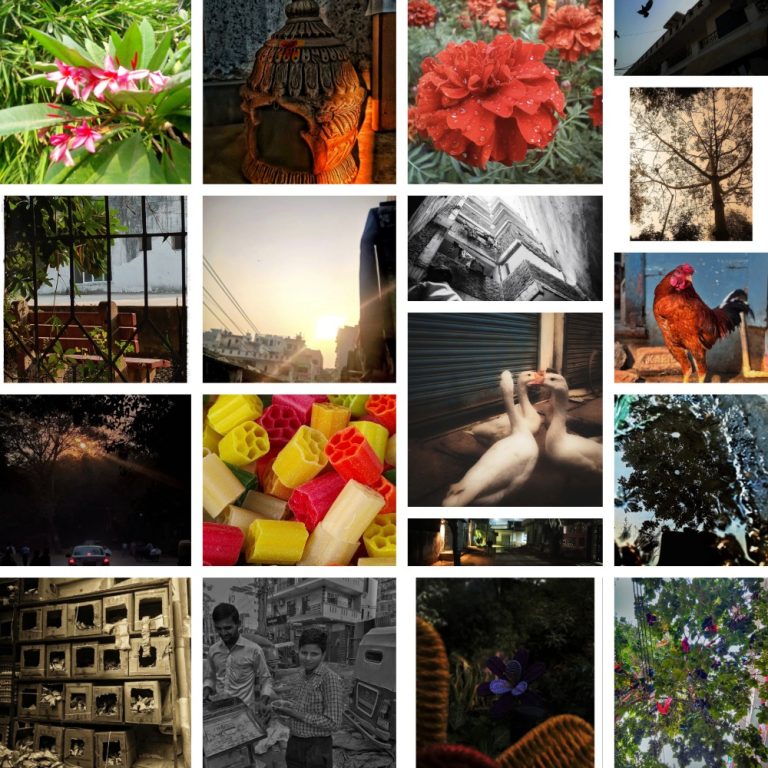
In Kolkata, older children stepped out of the classroom and into the city. Their task was to simply observe—and then draw and write. A tram became two lines of history in motion, Victoria Memorial turned into a misty storybook palace, a fishing boat on the Hooghly looked like a quiet dream, and the yellow taxi became a bright splash of hurry and hope. Armed only with a drawing book, colours and a teacher’s gentle prompts, they discovered that learning can also mean standing still, looking carefully and letting a city enter the page.

From Code to Robots: Children in the World of Technology
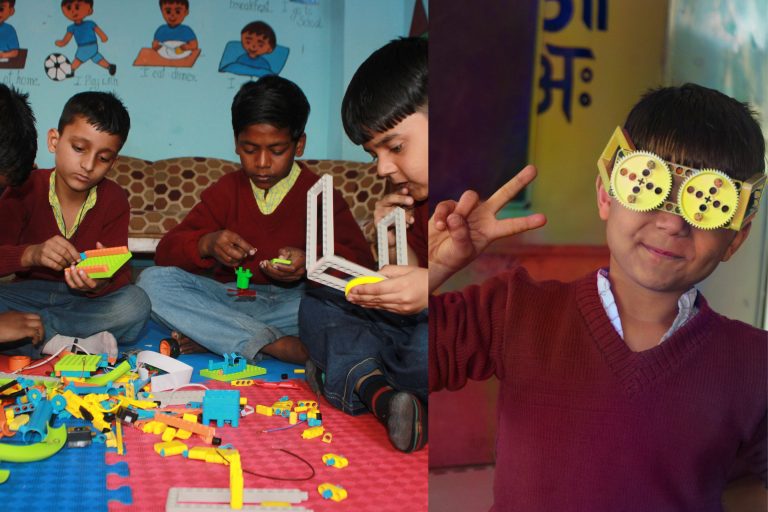
For many adolescents, Children’s Month meant entering the world of code and circuits. Through “Code for Earth”, students from multiple centres built apps and games around health, safety, environment and everyday problems—moving from playing games to designing solutions.

Another group travelled nearly 40 hours from North India to Kerala to compete at RoboVerse, returning with top prizes in Robo Sumo, Robo Soccer, Robo Race and Line Follower. These are children who once struggled for basic access to education, today they write code, assemble robots and stand on competition floors as equals.

Under the Supermoon: Astronomy Club in Action
When the Supermoon rose, 170 children from Mullahera, Vidyapeeth, Chhawla and satellite centres gathered for a special night with the Astronomy Club. Senior members guided younger ones through Sky Maps and a Constellation Hunting game, and then everyone took turns at the telescope to see Saturn with its rings, Titan, and the Moon’s craters up close. Later, an advanced Astronomy & Space Quiz for Classes 5–8 stretched older students’ minds with questions on galaxies, black holes, Indian space missions and more.
Special mention goes to Khushi (Grade IX), Ruchi (Grade VIII), Preeti (Grade VIII) from Bijwasan; Shweta (Grade IX) from Mullahera; and Shivani (Grade VIII) from Bajghera, who performed exceptionally well and kept asking for “more questions, please”.
Across these very different moments—song and dance in Lowakui, experiments in Leh, sketches in Kolkata, coding and robots in our tech programmes, stargazing and quizzes under the Supermoon—one thing was clear: children learn in many ways, at many speeds, with many dreams. Our work, year after year, is to keep creating such spaces so that, when they look back as adults, November is remembered not just as Children’s Day—but as a month when learning felt alive.